Showing posts with label Piscataqua. Show all posts

Sunday, December 20, 2009

Portsmouth building boom slowed by credit crunch

Fallout from the credit crisis and financial meltdown of 2007-2008 is still all around us these days. Even with improving conditions, you can hardly read a newspaper or watch the news on TV without some mention of the crisis and its impact. Although many people and businesses have been financially impacted, physical signs of the crisis are just now starting to show up on our local landscape.

Construction of hotel in Portwalk project (map)

I was in Portsmouth the other day and I did a quick photo shoot of some of the development projects underway. I had done a similar tour earlier in the year and while some of the projects seem to be going along strong, others have been delayed or scaled back. Causation can be hard to pinpoint, but it's probably a safe bet that many of the delays in these projects are due to financing issues or concerns about the economy.

In downtown Portsmouth, the Portwalk project is still moving along, although the developer split the project into three phases and is only working on phase I currently. Phase I includes a 128 room Residence Inn by Marriott and 12,000 sq feet of retail space. Phases II and III include condos (or maybe apartments), more office and commercial space, and a parking garage but seems to be on hold indefinitely at this point.

Rendering of the proposed Portwalk project (portwalkNH.com)

Parade Mall (Portwalk site) just before demolition (June 2009)

Parade Mall demolition (June 2009)

Shell of Residence Inn is nearly weather tight (Dec 2009)

View of Residence Inn from Maplewood and Deer (Dec 2009)


Rendering of Portwalk's Residence Inn from Hanover Street (portwalknh.com)

A Westin Hotel has also been approved across the street from the Portwalk project. The Westin project appeared ready to go, and the hotel was even listed on the Westin's website. However, there are no signs of construction and the hotel listing on the Westin website has been removed. There's no official word on the status of the project at this point.

Site of future Westin Hotel next to Deer Street in Portsmouth (map)

Also downtown, the Martingale Wharf project is just now coming out of a 9 month long stall. Work has recently started again on this 50,000 sq ft retail, commercial, and residential condo project on Bow Street after months of sitting idle.

Photo of Martingale Wharf project from across the river taken in June 2009 (map)


Photo from December shows little progress on the project since June

On the positive side, the project at the old Pier One Restaurant site (soon to be residential condos) appears to be moving along despite the tough economic conditions, as shown in the photo below.

Photo of work at the old Pier One Restaurant site at the end of State Street (map)

Finally, the City of Portsmouth project to relocate the waterfront deck at Poco's Restaurant and rehabilitate the public right-of-way seems to be coming along. With the construction of a new building at Martingale's Wharf, this area now offers the only riverfront view on this section of Bow Street.

View of small city park under construction behind Poco's Restaurant (map)

Additional links


Wednesday, September 2, 2009

Industry along the Piscataqua River - Westinghouse Electric Company

Ever wonder how much electricity it takes to run a 13,500 horsepower pump?

Westinghouse Electric's 178 Shattuck Way plant in Newington, NH

No? Me either. That is, until I found this power purchase contract from 2004 between the folks at Westinghouse Electric, in Newington, NH and Public Service Company of New Hampshire (PSNH). According to the document, Westinghouse has a special contract with PSNH for electricity to run its pump testing operation. These large pumps, up to 13,500 horsepower, are manufactured and tested at the Newington facility and are used in nuclear power plants around the world.

So how much power does it take to run a 13,500 horsepower pump? According to this "surprising energy facts" website, about 10 megawatts. The website says that's just a tad shy of the 15,000 horsepower produced by a single 747 engine. I guess it's convenient that Westinghouse's Newington facility is just a few hundred yards away from not one, not two, but three power generating plants that together can produce almost 1,200 megawatts of electricity. That's a good thing because otherwise, I'm sure the lights around Newington would dim just a little bit each time Westinghouse fired up one of their 13,500 horsepower pumps for testing.


Westinghouse Electric Company's 66,000 sq. ft Newington, NH facility manufactures components for nuclear power plants. Westinghouse Electric is headquartered in Pennsylvania, but in Newington, around 220 workers are employed producing between $20 and $50 million dollars worth of nuclear power plant components each year.

Westinghouse Electric is 77% owned by Toshiba, 20% owned by The Shaw Group, and 3% owned by Mitsubishi Heavy Industries. Westinghouse boasts on their web site that their designs are behind 50% of the 440 nuclear power plants in operation around the world today. I'm working on a post about the state of the nuclear power industry, but for now I'll just note that there seem to be three nuclear power plant designs currently vying for the various projects out for bid in the US, India, China, and elsewhere. These designs are the AP1000 from Westinghouse, the ESBWR and ABWR from GE-Hitachi, and the EPR from French owned Areva.

Cutaway View of Westinghouse Electric's new AP1000 reactor design

According to Westinghouse Electric's website, their their Newington plant manufactures reactor vessel internals, reactor coolant pumps, control element drive mechanisms, and pressure vessels of pumps and other components for nuclear power plants.

This 2002 SeacoastOnline article by Nicholas Brown does a nice job of sizing up what they are making.


Thursday, August 20, 2009

Industry Along the Piscataqua River - Tyco Telecommunications

My regular Internet reading list includes a handful of overseas publications, such as the Financial Times and The Economist.  When I load these sites in my web browser, or watch the occasional web video, there's seldom any noticeable delay, even though the data had to travel halfway across the world.  High speed transglobal communication is so ubiquitous that we barely pay notice to the amazing technology it takes to get the job done.

Tyco Telecommunications undersea cable plant - Newington, NH

It turns out, there's a manufacturing facility along the banks of the Piscataqua River in Newington, NH that played a major role in stitching together our global communications infrastructure. That facility is the Tyco Telecommunications undersea cable plant.


Tyco's Newington facility manufactures the so-called wet-plant components of undersea telecommunications cable systems.  This includes undersea cable and devices called repeaters that help keep the communication signals strong enough to reach their final destination.  


View Larger Map

The Newington plant has over 550,000 sq ft of manufacturing space and employs between 100-200 workers.  The facility also includes a deep water pier that allows direct ship loading of the cable that they make at the plant.

Deep water pier on the Piscataqua allows direct ship loading of undersea cable

Tyco's corporate website boasts that the company has installed over 420,000 kilometers of undersea cable worldwide.  That's enough cable to wrap the globe ten  times.  In addition, the company recently completed testing of a new cable system capable of transmitting data at 40 gigabits per second.  Just to put that into perspective, a 40 gigabit per second communications link could carry over half a million telephone calls,  over 50,000 simultaneous music streams, or over 5,000 HD video streams.

Unfortunately, despite these amazing technological achievements, the story of undersea cable manufacturing in NH is not all good news.  The crash of the tech bubble in the early 2000s, coupled with global telecommunications overcapacity that persists today, has resulted in several tough years for the folks at Tyco's Newington plant.  Tyco's footprint in NH, which at one time included over 1,500 workers at facilities in both Exeter and Newington, has shrunk to just 200 or so workers in Newington alone.

Monday, July 13, 2009

Industry Along the Piscataqua River - The Memorial Bridge


The Memorial Bridge in Portsmouth, NH has been in the news recently due to concerns about its safety and because of the high cost of some long overdue repairs.    The plan for its refurbishment was all set to go, but bids came in $15 million higher than expected.  That turned out to be a 35% cost increase, and it put the project on hold.

Well, it turns out that the bridge has a history of construction bids coming in higher than expected.

While I was googling around for information about industry along the Piscataqua, I stumbled on an interesting article about the Memorial Bridge's construction in a book by the American Society of Civil Engineers that dates back to 1922.   Thanks to the magic of Google Books and expiring copyrights, I was able to find and read this interesting little bit of history.

On September 14th, 1920, proposals were asked for the construction of the foundations and superstructure, in two separate bids. The two bids exceeded the amount available, $1,500,000, and the contracts were not awarded.

The original plans called for piers about 100 ft. long, with large sloping ice-breakers on the up-stream end, with a double Strauss lift bridge of 300 ft span. As the authorities were anxious to complete the bridge, further studies were made to reduce the cost. A Waddell lift span was substituted for the Strauss lift, and the piers were re-designed and made symmetrical by omitting the ice-breaker. The result of these studies was that contracts were let, the substructure being awarded to the Holbrook, Cabot and Rollins Corporation, and the superstructure to the American Bridge Company. The work was awarded in November, 1920, and the speaker's firm began immediately to get plant and material on the site.

I'm no structural engineer, so I had to do some more googling to learn what a double Strauss lift bridge and a Waddell Lift span were.  My task was slightly complicated because the double Strauss lift is a type of Bascule bridge and the Waddell lift is a type of vertical lift bridge.   BTW, you've got to check out those links if for no other reason than to see the cool animated gifs that show the bridges in action.  I'd sure be lost without Google and Wikipedia!

Anyhow, the book I mentioned is embedded below in Google's book reader.  If you click on "more about this book" on the bottom right of the reader,  you can read and even download the entire book (all 1900 pages) for free if you like. 


The article is titled "Difficult Foundation Problems for Piscataqua Bridge at Portsmouth, NH" and that's the real story of the article.  It goes into great detail about the engineering difficulty of setting the piers for the bridge in the fast-moving Piscataqua River.  The Piscataqua has some of the fastest currents of any river in North America and the challenges forced construction crews to build the two piers in fits and starts, improvising as they went along.  

After setting the foundation for the northern pier basically where they wanted, the crews were unable to find the expected bedrock in the river bottom to set the southern pier as planned.  Instead the foundation for the pier was set 12-19 feet below the river bottom in hardpan, which was determined to be good enough.

Despite the challenges and trips back to the drawing board, they did still manage to complete the bridge on time in 1922.  I suppose the fact that it's survived so well for over 95 years is a testament to their good workmanship and their ability to make good tradeoffs.

Below is a You tube video with some rough footage of the construction from the 1920s.


Finally, a few parting links on the bridge and some community efforts to save it:
> Save Our Bridges community group
Hartford Courant Elevates Memorial Bridge - SeacoastNH.com (7/09)
> Why Save Endangered Memorial Bridge? - SeacoastNH.com (12/08)
> Joined, Divided by a Bridge - boston.com (12/08)

Sunday, July 12, 2009

Industry Along the Piscataqua River - Sprague Energy

Entrance to Sprague Energy facility on River Road

The two tall concrete towers to the right in the photo above are recognizable landmarks to many in the NH Seacoast.  Perhaps you've noticed them while driving on the Spaulding Turnpike, kayaking on Great Bay, or hanging out at Wagon Hill Farm.  From a distance, they look like smoke stacks for a power plant.  It turns out, they're actually storage silos for Portland cement.  

View of Sprague Energy River Road facility from across the Piscataqua River

Sprague Energy operates two marine terminals along the Piscataqua River in Newington, NH and another storage and distribution facility in Portsmouth.  The Google Map below shows the locations of the three facilities.  The northern most facility is referred to as the River Road facility, while the middle one is called the Avery Lane facility, and the southern most facility is called the Portsmouth or Gosling Road facility.


View Sprague Energy Newington/Portsmouth NH in a larger map

You can see the clusters of storage tanks from the three facilities in the Google Map above.  The three facilities are as industrial-looking as anything on the Seacoast and some may think they're downright ugly.  But the truth is, these Sprague Energy facilities are an essential part of our local infrastructure.  Whenever you adjust your thermostat in the winter, light a burner on your propane stove, drive on a local road or over a local bridge, you may be using a product that passed through one of these facilities.

Here's an inventory of what's at the River Road facility:
> Five asphalt storage tanks (120,000 barrels total)
> Eleven petroleum products storage tanks (diesel, kerosene, jet fuel - 845,500 barrels)
> Two caustic-soda storage tanks (1.2 million gallons)
> Six tallow tanks (2.1 million gallons)
> One calcium-cloride storage tank (1.7 million gallons)
> Two cement storage silos (30,000 tons)
All of these storage tanks are connected to the marine terminal by pipelines so they can be filled from incoming tankers.  The storage tanks are also connected by pipeline to truck loading racks for distribution throughout the Seacoast and beyond. 

The River Road site also has open storage for 165,000 tons of salt and 120,000 tons of gypsum.  You can see the piles in the lower part of the Google map or in this bird's eye view from bing maps.

Tallow is the only export product stored at the facility.  Tallow is rendered animal fat and is used in production of soap, cosmetics, bird seed, and biodiesel, among other things. 

View of Sprague Energy Avery Lane facility from the Piscataqua River

The Avery Lane facility has the following:
> Seven asphalt storage tanks (218,000 barrels)
> Five storage tanks for other petroleum products (466,650 barrels)
> One Methyl-methacrylate tank (received only by rail)
> Two liquefied-petroleum-gas storage tanks (owned and operated by Sea-3)
Finally, the Gosling Road facility has three tanks that together can store 342,000 barrels of home heating oil.  These tanks are connected by pipeline to the marine terminal at Schiller Station.

Sprague Energy operates 20 marine terminals along the eastern seaboard and is headquartered at Pease International Tradeport in Portsmouth.  The company had estimated revenues in 2007 of $136 million and employs around 500 workers.  They are wholly owned by Axel Johnson Inc.


Tuesday, June 30, 2009

Industry Along the Piscataqua River - National Gypsum


National Gypsum Company (NGC) is the focus for today's post on Industry along the Piscataqua River.  NGC operates a gypsum wallboard manufacturing plant at 9 Michael J. Succi Drive in Portsmouth, NH.  The plant is one of two wallboard production plants on the banks of the Piscataqua.  It's been in operation since the early 1970s and underwent a major update in 1985.

The Google map below shows a bird's eye view of the Portsmouth plant.  You can clearly see the outline of the  long straight-line wallboard production process on the upper right of the map.  The National Gypsum website features a cool animation of the wallboard production process that somewhat explains why wallboard plants are laid out this way.


View Larger Map

Click here for a better bird's eye view from maps.bing.com

NGC is a privately held company headquartered in Charlotte, North Carolina.  According to the company's website, they operate several facilities spread across the US and in Canada including 17 wallboard plants,  7 mines and quarries, 7 interior finishing products plants, 3 paper plants, and 2 research facilities.   They employ  around 3,000 people and their annual revenues are estimated to be between $350 million and $500 million.  NGC also operates the largest gypsum quarry in the world, located outside Halifax, Nova Scotia.

Gypsum wallboard plants are often located near shipping terminals to facilitate efficient delivery of the bulky gypsum rock that they use as a raw material.  In addition, wallboard manufacturing plants require large amounts of energy to run kilns, rock dryers, rock crushers, and other equipment.  I stumbled on this 2004 NH DES permit report on the plant and was surprised to learn just how energy intensive wallboard manufacturing is.  Apparently, the NGC plant burns large amounts of fossil fuels in the production process and as with power plants, the facility's emissions are carefully monitored by state officials.

View of the National Gypsum wallboard facility from the Piscataqua River

The city of Portsmouth tax assessor's website shows the facility's assessment at $8.7 million with a $147,697 property tax bill for 2008.  According to nh.gov employment data, the Portsmouth, NH plant employs between 50 and 99 full-time workers.

Links

Monday, June 29, 2009

Industry Along the Piscataqua River - Introduction

Image courtesy of the Norman B. Leventhal Map Center at the Boston Public Library

The Piscataqua River,  located at the maritime border between New Hampshire and Maine, has been a focus for economic activity in New England since the earliest recorded human history in the area.  The river was used for centuries by the Abenaki people as a trade and migration route and later became a central transportation corridor for European settlers. 

The salt marshes along the banks of the river, and in Great Bay,  provided a familiar building material for early settlers and an important food source for their livestock.  In addition, the Piscataqua region's river system reached deep into New Hampshire, allowing easier transportation of New England's giant White Pine trees, which were sent to England and made into ship masts and bowsprits.  The tidal river also provided power for colonial saw mills that converted raw trees into lumber for use at home and for export.  The deep waters of the Piscataqua also supported a vibrant shipbuilding industry.

Today,  the Piscataqua continues to be an essential source of economic vitality for the region.  The river, along with the deep-water Portsmouth Harbor, is a strategic transportation resource for northern New England, carrying shipments of oil, gas, coal, chemicals, and minerals from near and distant ports.  The industries along the river are also an important source of employment in the region.


Below is a listing of some of the businesses and industrial sites located on the banks of the Piscataqua River in Kittery, Portsmouth, and Newington.  I'll provide more details on these in future posts.


Site/Business Name
Description

Portsmouth Naval Shipyard
Maintenance and repair of nuclear submarines and other vessels

NH State Pier
General shipping, container service, and warehousing

Granite State Minerals Inc.
Distributor of road salt and other bulk materials

National Gypsum
Gypsum wallboard manufacturing

Boise Cascade
Regional distribution center for building materials

Irving Oil Terminal
Energy products storage and distribution facility

Schiller Station
170 megawatt coal and biomass power plant

Newington Station
400 megawatt oil and natural gas power plant

Tyco Undersea Cable
Undersea communications cable manufacturing

Little Bay Lobster Company
Harvester and distributor of North Atlantic lobster

Georgia Pacific Gypsum
Gypsum wallboard manufacturing

Westinghouse Electric Inc.
Nuclear power plant components manufacturing

Newington Energy Facility
600 megawatt natural gas and oil fired power plant

Sprague Energy
Energy and chemical products storage and distribution facility

Finally, the map below shows the locations of the marine terminals on Portsmouth Harbor and along the Piscataqua.  A few of the sites listed above are not show on the map below because they do not have a marine terminal.

Monday, June 15, 2009

Piscataqua River Shipping - In Pictures

Since posting about the incident with the Torm Mary last week, I was inspired to capture some photos of a ship as it traveled up the Piscataqua River in Portsmouth, NH.  Having kayaked in the river myself very briefly, I can personally attest to the fast currents and lively waters that this tidal river is so famous for.   During each tide cycle, the entire volume of Great Bay as well as the flow from 5 large rivers pushes through the Piscataqua on its way to the Atlantic Ocean.

First, a view into how cargo was moved on the Piscataqua River in centuries past.  The Gundalow shown below is a replica of a design that dates back to the 1600s in Portsmouth.  These shallow draft vessels were essential in moving supplies and goods to and from early settlements along the rivers in Exeter, Newmarket, Durham, Dover, and Berwick, ME.


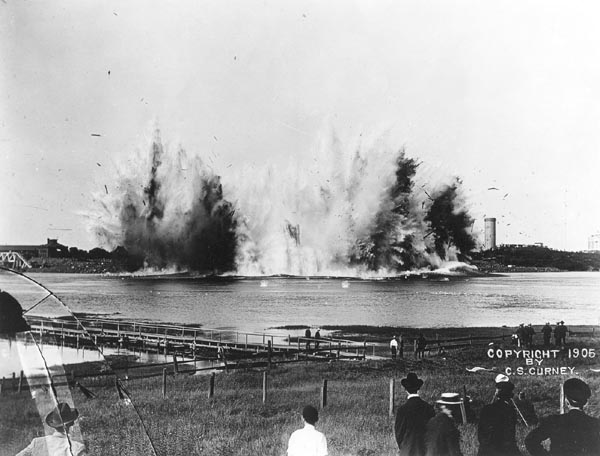
Since the early settlement of the area, the dangers of navigating the Piscataqua have been legendary.  In the 18th and 19th century, seafarers commented on the cross-grained and wily waters of the Piscataqua and even named a famously tough turn in the river "Pull-and-Be-Damned-Point."   They were actually referring to Henderson's point, in Kittery, which is just across from Newcastle.  In July of 1905, Henderson's point was the site of the largest explosion the world had ever seen, as workers attempted to rid the river of the treacherous rock outcropping at the behest of the US Navy.


Large ships can only navigate the Piscataqua during slack tide when the water is at its highest. I checked out the Moran Tug dock on Ceres Street to see if any of the three tugs were out.  With two of the three tugs missing, it was looking good for a large vessel to be on its way in.  

The map below shows the path of the vessel in the photos that follow.  You can click on the blue labels to see their names.


View Piscataqua Navigation in a larger map

The vessel "New England" approaches the Memorial Bridge.  You can see the Portsmouth Naval Shipyard behind it.  The vessel has just cleared the tough turn at Henderson's Point.

Next, the ship threads the needle through the Memorial Bridge.

Smoke pours from the stack of a tug as it struggles to push the vessel through the turn near Badger's Island.  You can see the Torm Mary, still docked at the state pier on the left.


That tug is still working hard to make sure the vessel gets around the bend ok.


One more needle to thread at the Sarah Long Bridge.


Once the ship makes it through the Sarah Long Bridge, it's just a few hundred more yards to the Irving Terminal.