Showing posts with label industry. Show all posts

Wednesday, December 23, 2009

Portsmouth based carbon capture firm completes pilot

Coal fired power plant in Bow, NH

I came across a recent report by SeacoastOnline about a company in Portsmouth called Powerspan that's doing some pretty cool work with carbon capture technology. Apparently, the firm just completed a pilot program on a 1 megawatt coal plant in Ohio that helped prove out their technology and lay the groundwork for a future commercial deployment.

Carbon capture is a technique that helps clean up the output from coal-fired power plants. In NH, PSNH is working on cleaning up emissions from our largest coal plant, Merrimack Station, but this effort will only remove mercury and sulfur dioxide, not carbon.

As I've mentioned before, for lots of reasons, coal is likely to be an important part of our energy mix for decades to come. Anything we can do to economically clean up the output from coal power plants is a good thing. It's neat that we've got a company right here in the seacoast of New Hampshire that's helping to solve this tough worldwide problem.

Although this is promising technology, Powerspan still has some big work ahead of them, especially in terms of economics. The firm's press release on the pilot indicates that using their technology will cost around $50 per ton of carbon removed from a coal plant's output. While this is apparently a breakthrough compared to competing carbon capture technologies, $50 per ton is still nothing to sneeze at.


Some very rough power generation costs (using $20 per ton for coal emissions)

For some perspective on that cost, consider the data in my power generation economics post from last July. In one of the later graphs, I priced carbon emissions at $20 per ton to show the impact of emissions on the economics of coal generation (see graph above). Generating a megawatt hour of power using coal can easily produce a ton of carbon emissions, so adding in a $50 per ton charge instead of $20 would significantly increase the cost of power from coal. In fact, adding $50 a ton for carbon capture would move coal's fuel and operating cost from 4.5 cents to 7.5 cents per kWh in the graph above. That could make coal uncompetitive versus other approaches.

Still, we shouldn't be too negative about the costs of carbon capture. The technology is still in its infancy and we're likely to see major breakthroughs along the way. Also, as long as we're subsidizing other emerging clean power generation technologies like wind and solar, it seems only right that carbon capture is included in the mix.

IMO, we should think of investing in power generation technology the way we think about personal investing. We should take a "portfolio" approach and diversify in order to minimize our risks and maximize opportunity. Even though wind and solar are showing great promise right now, we shouldn't put all our research eggs in one basket.

It's going to be a long haul to get to a cleaner energy future and I don't think anyone really knows what that future will look like. Personally, I'm glad to see these local folks working hard and smart to help us find the best way there.

Wednesday, September 2, 2009

Industry along the Piscataqua River - Westinghouse Electric Company

Ever wonder how much electricity it takes to run a 13,500 horsepower pump?

Westinghouse Electric's 178 Shattuck Way plant in Newington, NH

No? Me either. That is, until I found this power purchase contract from 2004 between the folks at Westinghouse Electric, in Newington, NH and Public Service Company of New Hampshire (PSNH). According to the document, Westinghouse has a special contract with PSNH for electricity to run its pump testing operation. These large pumps, up to 13,500 horsepower, are manufactured and tested at the Newington facility and are used in nuclear power plants around the world.

So how much power does it take to run a 13,500 horsepower pump? According to this "surprising energy facts" website, about 10 megawatts. The website says that's just a tad shy of the 15,000 horsepower produced by a single 747 engine. I guess it's convenient that Westinghouse's Newington facility is just a few hundred yards away from not one, not two, but three power generating plants that together can produce almost 1,200 megawatts of electricity. That's a good thing because otherwise, I'm sure the lights around Newington would dim just a little bit each time Westinghouse fired up one of their 13,500 horsepower pumps for testing.


Westinghouse Electric Company's 66,000 sq. ft Newington, NH facility manufactures components for nuclear power plants. Westinghouse Electric is headquartered in Pennsylvania, but in Newington, around 220 workers are employed producing between $20 and $50 million dollars worth of nuclear power plant components each year.

Westinghouse Electric is 77% owned by Toshiba, 20% owned by The Shaw Group, and 3% owned by Mitsubishi Heavy Industries. Westinghouse boasts on their web site that their designs are behind 50% of the 440 nuclear power plants in operation around the world today. I'm working on a post about the state of the nuclear power industry, but for now I'll just note that there seem to be three nuclear power plant designs currently vying for the various projects out for bid in the US, India, China, and elsewhere. These designs are the AP1000 from Westinghouse, the ESBWR and ABWR from GE-Hitachi, and the EPR from French owned Areva.

Cutaway View of Westinghouse Electric's new AP1000 reactor design

According to Westinghouse Electric's website, their their Newington plant manufactures reactor vessel internals, reactor coolant pumps, control element drive mechanisms, and pressure vessels of pumps and other components for nuclear power plants.

This 2002 SeacoastOnline article by Nicholas Brown does a nice job of sizing up what they are making.


Thursday, August 20, 2009

Industry Along the Piscataqua River - Tyco Telecommunications

My regular Internet reading list includes a handful of overseas publications, such as the Financial Times and The Economist.  When I load these sites in my web browser, or watch the occasional web video, there's seldom any noticeable delay, even though the data had to travel halfway across the world.  High speed transglobal communication is so ubiquitous that we barely pay notice to the amazing technology it takes to get the job done.

Tyco Telecommunications undersea cable plant - Newington, NH

It turns out, there's a manufacturing facility along the banks of the Piscataqua River in Newington, NH that played a major role in stitching together our global communications infrastructure. That facility is the Tyco Telecommunications undersea cable plant.


Tyco's Newington facility manufactures the so-called wet-plant components of undersea telecommunications cable systems.  This includes undersea cable and devices called repeaters that help keep the communication signals strong enough to reach their final destination.  


View Larger Map

The Newington plant has over 550,000 sq ft of manufacturing space and employs between 100-200 workers.  The facility also includes a deep water pier that allows direct ship loading of the cable that they make at the plant.

Deep water pier on the Piscataqua allows direct ship loading of undersea cable

Tyco's corporate website boasts that the company has installed over 420,000 kilometers of undersea cable worldwide.  That's enough cable to wrap the globe ten  times.  In addition, the company recently completed testing of a new cable system capable of transmitting data at 40 gigabits per second.  Just to put that into perspective, a 40 gigabit per second communications link could carry over half a million telephone calls,  over 50,000 simultaneous music streams, or over 5,000 HD video streams.

Unfortunately, despite these amazing technological achievements, the story of undersea cable manufacturing in NH is not all good news.  The crash of the tech bubble in the early 2000s, coupled with global telecommunications overcapacity that persists today, has resulted in several tough years for the folks at Tyco's Newington plant.  Tyco's footprint in NH, which at one time included over 1,500 workers at facilities in both Exeter and Newington, has shrunk to just 200 or so workers in Newington alone.

Sunday, August 16, 2009

Cash for Clunkers - What's in it for NH?

Park Nameplate Company - Dover, NH manufacturing plant

At first glance, it might seem like the "Cash for Clunkers" auto rebate program is a targeted effort to help the Big Three automakers and provide some relief to Detroit's economy.  Many in NH may think that the program will only benefit auto manufacturers in far away states, and doesn't have much to do with NH's economy.  I sure did at first, but  after some digging, I learned that's not the whole story.

For some background, you might want to check out how  Wikipedia describes the Cash for Clunkers program:
The Car Allowance Rebate System (CARS), colloquially known as "Cash for Clunkers," is a U.S. federal scrappage program intended to provide economic incentives to U.S. residents to purchase a new, more fuel efficient vehicle when trading in a less fuel efficient vehicle. The program was designed to provide stimulus to the economy by boosting auto sales, while putting safer, cleaner and more fuel-efficient vehicles on the roadways. Although the program officially started on July 1, 2009, the processing of claims did not begin until July 24.
The $3 billion program, which represents around 0.3% of total stimulus spending, has been criticized for being wasteful and for falling short of its goals.  Econobrowser blogger and UC San Diego Professor James Hamilton recently compared the program with a New Deal era initiative to slaughter livestock.  Meanwhile, Science Daily reported on a UC Davis study that estimates the cost of reducing carbon emissions under the program at $237 per ton.  Carbon emissions in europe are currently $20 per ton and in the US they're expected to cost around $28 under the proposed cap-and-trade legislation.

Controversy aside,  I wanted to learn more about automobile sector employment, especially in NH.   I found a good high level summary at the US Bureau of Labor Statistics.  The table below gives a good overview of automobile industry employment in the US.  Aside from the recent steep drop in employment overall, the first thing that caught my eye was that parts manufacturing employs more than twice as many workers as pure auto manufacturing.  The next surprise was that parts manufacturers,  parts retailers and wholesalers, and auto dealers together employ over 10 workers for every one motor vehicle manufacturing worker.


Another surprise (for me anyway) came from this research report by an industry group called The Center for Automotive Research (CAR).  The introduction says that in 2007 there were around 239,000 auto workers employed by the Detroit Three, while there were 113,000 workers employed in the US by foreign auto makers.  I didn't realize that there were that many "foreign" auto manufacturing jobs in the US.

For me, this all says that while Detroit's economy may be all about the auto industry, the auto industry is definitely not just a story about Detroit.  I wondered what that might mean in terms of New Hampshire's auto related employment as compared to auto employment in the nation as a whole.

Michael Cousineau at the Union Leader did a great report back in June about auto industry related employment in NH. (Automotive Industry Ripple Effect in New Hampshire - via the Urethane Blog since UL archives old articles).  In this report, Mr. Cousineau details auto industry employment in NH and profiles a couple of auto parts manufacturers, including Park Nameplate in Dover (pictured above).


Mr.  Cousineau's article says that in NH there are over 900 companies providing around 17,000 auto related jobs.  That compares with around 21,000 construction jobs and around 61,000 jobs in the hospitality sector in NH (source: NHES August 2009 report).  

Finally, to put this all together, I wanted to get a sense of NH's share of total auto sector jobs compared to the US overall.  To determine this, I first had to gather up some stats:
Total nonfarm employment in the US -> 132 million
Total nonfarm employment in NH  -> 633,000
Total auto employment in the US -> 2.653 million
Total auto employment in NH -> 17,000
Some quick math on the stats above reveals that in the US, there are around 49 non auto workers for each auto industry worker (132/2.653).  In NH, there are only 36 non auto workers for each auto worker (633,000/17,000) .  So it appears that a higher proportion of the jobs in NH are auto jobs as compared to the proportion in the US overall.   (another way to think of this is that NH has .48% of total US employment (633k/132m) and .64% of total US auto employment (17k/2.653m) 

The math may seem confusing, but as long as I did it right, it does answer my original question.  It turns out we have more than our share of auto jobs here in NH.

So in the end, whatever the costs and benefits of the Cash for Clunkers program, it seems reasonable to expect that NH will get at least its share of the economic stimulus generated by this program.

(Aside: Not to feed the crazy too much, but there was an interesting kerfuffle over the cars.gov website and its rather overzealous terms of service.)

Monday, July 27, 2009

Got Milk? - Chicago Mercantile Exchange Edition

Did the investment choices of a pension fund manager in California affect the welfare of dairy farmers in Stratham, NH?

SeacoastOnline.com recently published an article by Michael Mccord about how the recent drop in milk prices is hurting a local dairy farmer in Stratham, NH.  Something Mr. Mccord wrote toward the end of the article really caught my attention:

Taylor said one aspect of the price setting formula needs to change immediately because it's connected to commodity prices set by the Chicago Mercantile Exchange — which has become a proven ground for ever more-complicated derivative investment schemes designed to turn quick profits, not unlike the same ones that produced mortgage-backed securities and credit default swaps.

"It's fairly obvious there's speculation, we know there's speculation," Taylor said. And there's little the local dairy farmer can do to stop it.

Financial speculators running wild in the milk market? What's up with that?  

It turns out that under the US government's Byzantine agricultural price support program, the price paid to dairy farmers for their milk is indirectly connected to prices set on the Chicago Mercantile Exchange for butter and cheddar cheese.  So when the spot price of butter or cheese increases on the Chicago Mercantile Exchange, The Stuart Farm in Stratham is likely to get a better price for their milk.  Likewise, if commodity prices collapse, it can really hurt local dairy farmers.

You may recall that last year some politicians were blaming high gas prices on commodities speculators.   The concern was that people with no interest in an underlying commodity were making big bets on future prices and by doing so, were impacting the prices of the underlying commodity.  Most of the fuss was about oil speculators, but the same forces were at work in other commodities.   

Now back to milk prices.   The graph below shows the wholesale price of milk since 1995.   The price is quoted in something called dollars per hundredweight ($/cwt).  You can see that the price is quite volatile.  In just the last year the price has ranged from under $10 to well over $20.  It'd sure be tough to run any kind of business when the market price for your output is bouncing around like that.

Milk price data from USDA through wisc.edu

Next, to see how the fortunes of dairy farmers appear tied to those of commodities traders, take a look at the graph below of the price of milk vs the CRB foodstuffs index.  This well known commodity index does have butter in it, but it also has 9 other commodities including corn, sugar, hogs, soybean oil and wheat.  Aside from a general uptrend from inflation, there's no clear reason why the price of milk would be correlated to this broad agricultural index.

Commodity index data from the Commodities Research Bureau (CRB)

But as you can see from the graph above, the two lines may not trace identical paths, but they definitely rhyme.  It sure seems like the prices of unrelated commodities may be impacting the price paid to NH dairy farmers for their milk.  At the least, something is causing milk and a diverse basket of agricultural commodities to be very highly correlated.

Maybe you're skeptical, since the CRB foodstuffs index is comprised of only agricultural products?  The graph below shows the price of milk vs the CRB commodity spot index.  This index includes everything in the foodstuffs index plus metals, textiles,  industrial materials, and livestock.  Since it contains a broad mix of unrelated commodities, it isn't nearly as volatile as the price of milk.  Still, there does seem to be a connection.


The plot of most commodity indices looks roughly similar to the green line in the graph above.  That line clearly shows that between 2005 and 2008, the world was in the grips of a nasty commodities bubble that impacted the prices of nearly all commodities, including milk.   For us here in NH, the most immediate impact of this bubble was a sharp spike in the price of gasoline, home heating oil, groceries, and other essentials, followed by an abrupt crash late last year.

Ok, so how does all this explain a how a pension fund in California could impact the price of milk in Stratham, you might ask?  Well,  the "speculators" that got the blame for high gas prices, and even the high milk prices, were often portfolio managers for pension funds, college endowments and other investment firms.   The charge was that all this new money entering the commodities market inflated prices, and when the market fell last year, these same speculators rushed for the exits and caused commodity prices to plummet.

Although there were certainly speculators, the big money flowing into commodities between 2005-2008 wasn't speculating as much as hedging.  Large institutional portfolio managers, such as CalPERS, the retirement system in California, were just doing what their investment textbooks said they should do.  They were following recent asset allocation research that suggested holding a broad basket of commodities futures could help immunize them from the ravages of high inflation and reduce the overall riskiness of their investment portfolio.

Economists disagree on the impact of  these new commodities investors.  Since they don't consume the commodities they invest in, many economists think their impact is limited.   Economics blogger and Professor James Hamilton did a pretty extensive analysis on the topic.  His conclusion was that speculators along with these new commodities investors may increase price volatility, but their impact is mostly temporary and wasn't the primary driver of the commodities bubble.  Many economists believe that the commodities bubble was a natural result of strong worldwide economic growth through early 2008.  They believe increased demand from several emerging economies, such as China and India, strained the supply of all commodities and that's why the prices of seemingly unrelated commodities increased together.

Regardless of whether the impact on prices of commodities by pension fund investors was transient or more sustained, most agree that the inflow of institutional money from sources such as CalPERS has been a big factor in the volatility of commodity markets over the last few years.  There's little doubt that this added volatility has at least played a role in the pain felt by dairy farmers in places like Stratham, NH. 

Sunday, July 12, 2009

Industry Along the Piscataqua River - Sprague Energy

Entrance to Sprague Energy facility on River Road

The two tall concrete towers to the right in the photo above are recognizable landmarks to many in the NH Seacoast.  Perhaps you've noticed them while driving on the Spaulding Turnpike, kayaking on Great Bay, or hanging out at Wagon Hill Farm.  From a distance, they look like smoke stacks for a power plant.  It turns out, they're actually storage silos for Portland cement.  

View of Sprague Energy River Road facility from across the Piscataqua River

Sprague Energy operates two marine terminals along the Piscataqua River in Newington, NH and another storage and distribution facility in Portsmouth.  The Google Map below shows the locations of the three facilities.  The northern most facility is referred to as the River Road facility, while the middle one is called the Avery Lane facility, and the southern most facility is called the Portsmouth or Gosling Road facility.


View Sprague Energy Newington/Portsmouth NH in a larger map

You can see the clusters of storage tanks from the three facilities in the Google Map above.  The three facilities are as industrial-looking as anything on the Seacoast and some may think they're downright ugly.  But the truth is, these Sprague Energy facilities are an essential part of our local infrastructure.  Whenever you adjust your thermostat in the winter, light a burner on your propane stove, drive on a local road or over a local bridge, you may be using a product that passed through one of these facilities.

Here's an inventory of what's at the River Road facility:
> Five asphalt storage tanks (120,000 barrels total)
> Eleven petroleum products storage tanks (diesel, kerosene, jet fuel - 845,500 barrels)
> Two caustic-soda storage tanks (1.2 million gallons)
> Six tallow tanks (2.1 million gallons)
> One calcium-cloride storage tank (1.7 million gallons)
> Two cement storage silos (30,000 tons)
All of these storage tanks are connected to the marine terminal by pipelines so they can be filled from incoming tankers.  The storage tanks are also connected by pipeline to truck loading racks for distribution throughout the Seacoast and beyond. 

The River Road site also has open storage for 165,000 tons of salt and 120,000 tons of gypsum.  You can see the piles in the lower part of the Google map or in this bird's eye view from bing maps.

Tallow is the only export product stored at the facility.  Tallow is rendered animal fat and is used in production of soap, cosmetics, bird seed, and biodiesel, among other things. 

View of Sprague Energy Avery Lane facility from the Piscataqua River

The Avery Lane facility has the following:
> Seven asphalt storage tanks (218,000 barrels)
> Five storage tanks for other petroleum products (466,650 barrels)
> One Methyl-methacrylate tank (received only by rail)
> Two liquefied-petroleum-gas storage tanks (owned and operated by Sea-3)
Finally, the Gosling Road facility has three tanks that together can store 342,000 barrels of home heating oil.  These tanks are connected by pipeline to the marine terminal at Schiller Station.

Sprague Energy operates 20 marine terminals along the eastern seaboard and is headquartered at Pease International Tradeport in Portsmouth.  The company had estimated revenues in 2007 of $136 million and employs around 500 workers.  They are wholly owned by Axel Johnson Inc.


Tuesday, June 30, 2009

Industry Along the Piscataqua River - National Gypsum


National Gypsum Company (NGC) is the focus for today's post on Industry along the Piscataqua River.  NGC operates a gypsum wallboard manufacturing plant at 9 Michael J. Succi Drive in Portsmouth, NH.  The plant is one of two wallboard production plants on the banks of the Piscataqua.  It's been in operation since the early 1970s and underwent a major update in 1985.

The Google map below shows a bird's eye view of the Portsmouth plant.  You can clearly see the outline of the  long straight-line wallboard production process on the upper right of the map.  The National Gypsum website features a cool animation of the wallboard production process that somewhat explains why wallboard plants are laid out this way.


View Larger Map

Click here for a better bird's eye view from maps.bing.com

NGC is a privately held company headquartered in Charlotte, North Carolina.  According to the company's website, they operate several facilities spread across the US and in Canada including 17 wallboard plants,  7 mines and quarries, 7 interior finishing products plants, 3 paper plants, and 2 research facilities.   They employ  around 3,000 people and their annual revenues are estimated to be between $350 million and $500 million.  NGC also operates the largest gypsum quarry in the world, located outside Halifax, Nova Scotia.

Gypsum wallboard plants are often located near shipping terminals to facilitate efficient delivery of the bulky gypsum rock that they use as a raw material.  In addition, wallboard manufacturing plants require large amounts of energy to run kilns, rock dryers, rock crushers, and other equipment.  I stumbled on this 2004 NH DES permit report on the plant and was surprised to learn just how energy intensive wallboard manufacturing is.  Apparently, the NGC plant burns large amounts of fossil fuels in the production process and as with power plants, the facility's emissions are carefully monitored by state officials.

View of the National Gypsum wallboard facility from the Piscataqua River

The city of Portsmouth tax assessor's website shows the facility's assessment at $8.7 million with a $147,697 property tax bill for 2008.  According to nh.gov employment data, the Portsmouth, NH plant employs between 50 and 99 full-time workers.

Links

Monday, June 29, 2009

Industry Along the Piscataqua River - Introduction

Image courtesy of the Norman B. Leventhal Map Center at the Boston Public Library

The Piscataqua River,  located at the maritime border between New Hampshire and Maine, has been a focus for economic activity in New England since the earliest recorded human history in the area.  The river was used for centuries by the Abenaki people as a trade and migration route and later became a central transportation corridor for European settlers. 

The salt marshes along the banks of the river, and in Great Bay,  provided a familiar building material for early settlers and an important food source for their livestock.  In addition, the Piscataqua region's river system reached deep into New Hampshire, allowing easier transportation of New England's giant White Pine trees, which were sent to England and made into ship masts and bowsprits.  The tidal river also provided power for colonial saw mills that converted raw trees into lumber for use at home and for export.  The deep waters of the Piscataqua also supported a vibrant shipbuilding industry.

Today,  the Piscataqua continues to be an essential source of economic vitality for the region.  The river, along with the deep-water Portsmouth Harbor, is a strategic transportation resource for northern New England, carrying shipments of oil, gas, coal, chemicals, and minerals from near and distant ports.  The industries along the river are also an important source of employment in the region.


Below is a listing of some of the businesses and industrial sites located on the banks of the Piscataqua River in Kittery, Portsmouth, and Newington.  I'll provide more details on these in future posts.


Site/Business Name
Description

Portsmouth Naval Shipyard
Maintenance and repair of nuclear submarines and other vessels

NH State Pier
General shipping, container service, and warehousing

Granite State Minerals Inc.
Distributor of road salt and other bulk materials

National Gypsum
Gypsum wallboard manufacturing

Boise Cascade
Regional distribution center for building materials

Irving Oil Terminal
Energy products storage and distribution facility

Schiller Station
170 megawatt coal and biomass power plant

Newington Station
400 megawatt oil and natural gas power plant

Tyco Undersea Cable
Undersea communications cable manufacturing

Little Bay Lobster Company
Harvester and distributor of North Atlantic lobster

Georgia Pacific Gypsum
Gypsum wallboard manufacturing

Westinghouse Electric Inc.
Nuclear power plant components manufacturing

Newington Energy Facility
600 megawatt natural gas and oil fired power plant

Sprague Energy
Energy and chemical products storage and distribution facility

Finally, the map below shows the locations of the marine terminals on Portsmouth Harbor and along the Piscataqua.  A few of the sites listed above are not show on the map below because they do not have a marine terminal.

Wednesday, June 17, 2009

MVP Series - Dover Edition #1

What are the Most Valuable Properties in towns and cities near you?

According to the City of Dover's  2008 Property Assessment Report, Liberty Mutual Group, an insurance company at 100 Liberty Way, owns the most valuable property in Dover, NH.


The Liberty Mutual campus actually consists of three buildings, the oldest was built in 1996 and the newest in 2007.

Here are some quick facts about Liberty Mutual's Dover campus:
>  2008 property tax assessment is $74 million - over $1.5 million in taxes paid
>  225 acre campus with 3 buildings
>  newest building is 350,000 sq ft and cost over $50 million to construct
>  3500 people employed at facility


With 3500 workers at the Dover campus alone, Liberty Mutual is the largest employer in the city.  The next largest employers are the City of Dover, employing 1139 people, and Wentworth-Douglass Hospital, employing 1048.


Quick facts about Liberty Mutual Group (LMG)
>  $28.855 billion in 2008 revenue
>  5th largest property casualty insurer in the US
>  Ranks 86th on the Fortune 500 list of largest US corporations
>  Company type: Private Mutual (not publicly traded)
>  Headquarters in Boston, MA

Google map of the campus (unfortunately it doesn't show the newest building)

View Larger Map

Links:

Monday, June 15, 2009

Piscataqua River Shipping - In Pictures

Since posting about the incident with the Torm Mary last week, I was inspired to capture some photos of a ship as it traveled up the Piscataqua River in Portsmouth, NH.  Having kayaked in the river myself very briefly, I can personally attest to the fast currents and lively waters that this tidal river is so famous for.   During each tide cycle, the entire volume of Great Bay as well as the flow from 5 large rivers pushes through the Piscataqua on its way to the Atlantic Ocean.

First, a view into how cargo was moved on the Piscataqua River in centuries past.  The Gundalow shown below is a replica of a design that dates back to the 1600s in Portsmouth.  These shallow draft vessels were essential in moving supplies and goods to and from early settlements along the rivers in Exeter, Newmarket, Durham, Dover, and Berwick, ME.


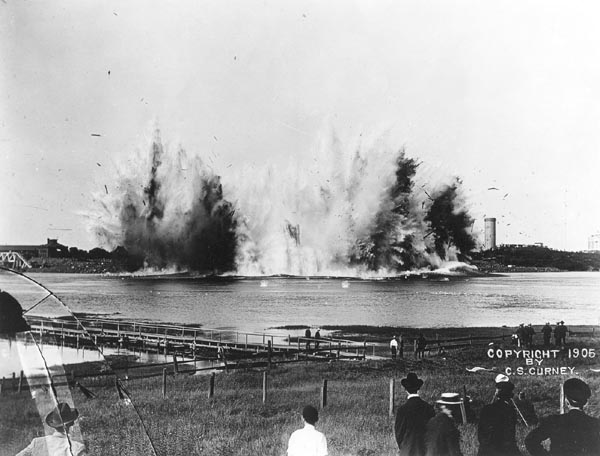
Since the early settlement of the area, the dangers of navigating the Piscataqua have been legendary.  In the 18th and 19th century, seafarers commented on the cross-grained and wily waters of the Piscataqua and even named a famously tough turn in the river "Pull-and-Be-Damned-Point."   They were actually referring to Henderson's point, in Kittery, which is just across from Newcastle.  In July of 1905, Henderson's point was the site of the largest explosion the world had ever seen, as workers attempted to rid the river of the treacherous rock outcropping at the behest of the US Navy.


Large ships can only navigate the Piscataqua during slack tide when the water is at its highest. I checked out the Moran Tug dock on Ceres Street to see if any of the three tugs were out.  With two of the three tugs missing, it was looking good for a large vessel to be on its way in.  

The map below shows the path of the vessel in the photos that follow.  You can click on the blue labels to see their names.


View Piscataqua Navigation in a larger map

The vessel "New England" approaches the Memorial Bridge.  You can see the Portsmouth Naval Shipyard behind it.  The vessel has just cleared the tough turn at Henderson's Point.

Next, the ship threads the needle through the Memorial Bridge.

Smoke pours from the stack of a tug as it struggles to push the vessel through the turn near Badger's Island.  You can see the Torm Mary, still docked at the state pier on the left.


That tug is still working hard to make sure the vessel gets around the bend ok.


One more needle to thread at the Sarah Long Bridge.


Once the ship makes it through the Sarah Long Bridge, it's just a few hundred more yards to the Irving Terminal.

Saturday, June 6, 2009

MVP Series - Portsmouth Edition #1

What are the Most Valuable Properties in towns and cities near you?

According to the Portsmouth tax collector's office, Lonza Biologics Inc owns the most valuable property in Portsmouth, NH.  The 18 acre property, located at the Pease International Tradeport at 101 International Drive, is assessed at over $110 million dollars.  Lonza's a 2008 property tax bill came in at just under $1.9 million.

       Photo courtesy of Lonza Group Ltd.

Lonza Group Ltd, which owns Lonza Biologics Inc. in Portsmouth, is a Swiss company headquartered in Basel. The Lonza Biologics website describes the Portsmouth facility as a production site that "specializes in the large scale custom manufacture of recombinant therapeutic proteins and monoclonal antibodies by mammalian cell culture."  

Right.  I'll get to that that later.  First, here are some quick facts about Lonza's Portsmouth facility:
Area: 350,000sq ft
Employees: 642
Plants/Processes:

> Processes based on mammalian cell culture
> Four 20 000-liter bioreactor trains
> Two 5,000-liter bioreactor trains
> Two 1500-liter perfusion bioreactor trains
So in addition to having the largest tax bill in the city of Portsmouth, Lonza is an important employer in the region and is a major contributor to the NH Seacoast's economic vitality.   Since arriving in Portsmouth in 1999, the Lonza facility has been expanded multiple times.

But just what does Lonza manufacture in Portsmouth?  I'm not sure about you, but when I think about a big manufacturing plant, the first things that come to mind are cars, refrigerators, and big-screen TVs.  I might even imagine chemical products like household cleaners and personal care items.  I definitely would not think of "Recombinant therapeutic proteins and monoclonal antibodies made by mammalian cell culture." What does that mean anyway?

What follows is a layperson's attempt to parse and understand what Lonza does in Portsmouth.  The biotech industry is very competitive and therefore rather secretive, so precise information is tough to track down and verify.  If anyone knows better or if  I've gotten something wrong, please correct me in the comments.

In Portsmouth, Lonza does something called "contract manufacturing," which means that they manufacture products on behalf of other companies which generally own the designs and rights to the products.  Many industries use contract manufacturers because the expertise needed for product design and development is very different from what's needed to be an efficient and high quality manufacturer.  In medical manufacturing, there's also a complex maze of safety and  regulatory requirements that a manufacturer must navigate.  These headaches can all be handled by hiring a reliable contract manufacturer.

So in short, Lonza enters into agreements with pharmaceutical companies, such as Genentech, Amgen, Bristol-Myers Squibb, or Eli Lilly to manufacture products or parts of products to exacting specifications on their behalf.  The pharmaceutical companies get reliably manufactured products, and Lonza makes a good living while employing lots of folks in Portsmouth.

Some examples of drugs that a facility like Portsmouth's might help make are shown below:
Avonex - Multiple Sclerosis
Xigris - Sepsis
Rituxan – Non-Hodgkin's Lymphoma
Enbrel – Rheumatoid Arthritis
Soliris – PNH
Orencia - Rheumatoid Arthritis
Generally, Portsmouth's Lonza plant doesn't make actual medicines prescribed by doctors, instead it makes important ingredients that are used in the medicines.  No doubt, the Portsmouth facility is a high-tech wonder.  Creating the processes to reliably and safely mass produce pharmaceutical companies' inventions seems like no small task, especially when you consider that many of the substances they're making are actually alive.

If you're interested in further reading, here are a few additional links:

Finally, some additional press photos of the Portsmouth, NH facility are shown below
(courtesy of The Lonza Group,Ltd):

20,000 liter bioreactor

Purification suite

Media preparation area

Buffer hold suite in large scale